

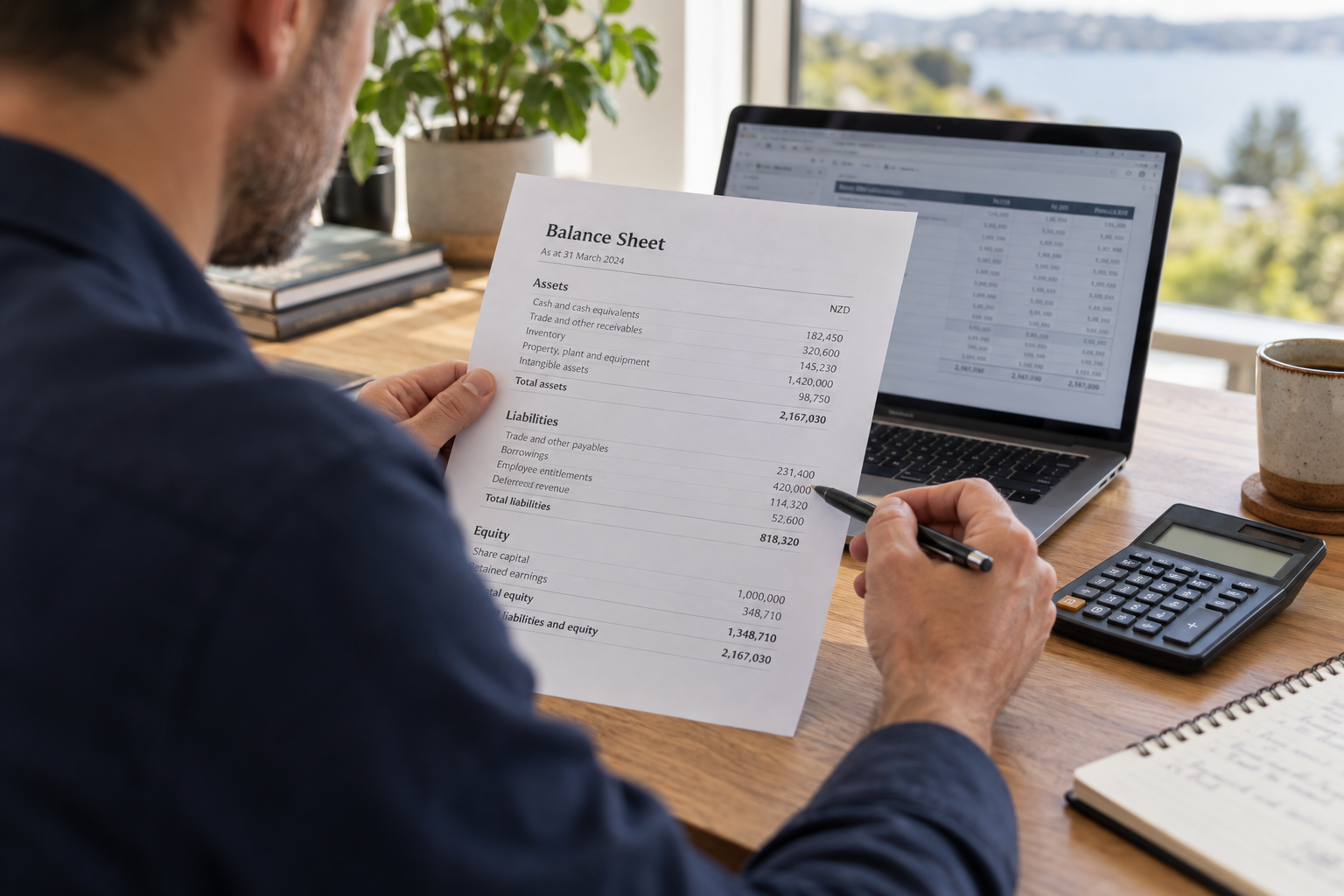
Many business owners spend time looking at sales, expenses and profit but give their balance sheet only a quick glance. It may be included with annual accounts or available in accounting software, yet its figures can feel less familiar than the numbers on a profit and loss statement.
That is a missed opportunity. Your balance sheet can help you see what customers owe you, what you owe others and how much of the business’s resources are tied up in stock, equipment or unpaid invoices. It can also reveal why a profitable business is short of cash.
You do not need to become an accountant to use it. Start by understanding what the report shows, checking that the figures make sense and asking how they have changed over time.
This guide explains the main sections of a balance sheet and gives New Zealand business owners practical questions to ask when reviewing one.
What is a balance sheet?
A balance sheet shows a business’s financial position on a particular date. It groups information into three main parts:
Assets: What the business owns or is owed
Liabilities: What the business owes
Equity: The remaining interest after liabilities are deducted from assets
These parts follow a basic equation:
Assets = Liabilities + Equity
For example, if a business has total assets of $300,000 and total liabilities of $180,000, its equity is $120,000. The figures are a snapshot on the balance sheet date; they will change as the business trades, customers pay and debts are settled. Business.govt.nz uses the same assets, liabilities and equity framework in its guide to understanding a balance sheet.
The balance sheet answers a different question from your profit and loss statement. Your profit and loss statement shows income and expenses over a period. The balance sheet shows what the business owns and owes at a point in time. Reading both helps you understand where profit has gone and what obligations remain.
Affinity has an existing guide to reading your profit and loss statement. This article is its companion: it takes a closer look at the financial position behind those trading results.
Start by checking the date
Before looking at any figure, check the date at the top of the report.
A balance sheet dated 31 March tells you what was recorded at that date. It does not show everything that has happened since. If you are considering an investment in September, a balance sheet from the previous March may be useful background, but you will also need more recent information.
Where possible, compare the latest balance sheet with an earlier one. The same date in the previous year can help account for seasonal patterns. Comparing month to month may show whether unpaid customer invoices, stock or debt are increasing.
One number in isolation often tells you little. A trend gives you something to investigate.
Check, too, whether the bookkeeping behind the report is current. If recent bank transactions have not been reconciled or supplier invoices have not been entered, the balance sheet may not accurately reflect the business’s position. Ask your accountant or bookkeeper about figures that seem incomplete or unexpected before making a decision based on them.
Understand what sits under assets
Assets are the resources the business holds or amounts it expects to receive. Your balance sheet may divide them into current assets, generally expected to turn into cash or be used in the shorter term, and longer-term assets.
Common examples include cash in bank accounts, unpaid customer invoices, stock, equipment and vehicles. A business may have a large total asset figure while having relatively little cash available today.
Consider a business with $120,000 in current assets. That might sound comfortable. But suppose $70,000 is stock, $40,000 is unpaid customer invoices and only $10,000 is in the bank. The business cannot use all $120,000 to pay a bill this afternoon.
As you review assets, ask:
How much cash is actually available?
Which customer invoices are still unpaid?
How old are those invoices?
Is stock moving at the rate we expected?
Are equipment values and asset records up to date?
This is why the detail matters more than the total alone. Assets can support the business in different ways, but they do not all turn into cash at the same speed.
Look closely at customer invoices
Accounts receivable, sometimes called debtors, represents amounts customers owe the business. A growing figure can reflect healthy sales, but it can also be an early sign that payments are slowing.
Compare the total with recent sales and review how long invoices have been outstanding. Is the increase spread across many customers, or concentrated in one large account? Have jobs been invoiced correctly and promptly? Are there disputes holding up payment?
An invoice may be recorded as an asset because the customer owes you money. Until it is paid, however, it cannot fund payroll or a supplier payment. Business.govt.nz distinguishes these unpaid amounts from cash when explaining how the balance sheet and cash flow information work together.
If debtors continue to rise, agree on a follow-up process. That might involve clearer payment terms, more timely invoicing or a review of credit given to customers.
Ask whether stock is working for the business
For a business that holds inventory, stock can be a substantial balance sheet asset. It also represents money that has already been spent.
An increase in stock may be sensible if you are preparing for confirmed demand. It deserves attention if items are sitting longer than expected or becoming difficult to sell. Stock that looks valuable on a report may require discounting or may no longer suit what customers want.
Compare stock levels with sales, purchasing plans and what is physically on hand. If there is a mismatch, your records may need updating. If a large amount of cash is tied up in slow-moving products, review purchasing decisions before placing another order.
A service business may have little or no stock. For that business, unpaid invoices or work in progress may be more useful areas to examine.
Understand what the business owes
Liabilities are obligations the business needs to settle. They can include unpaid supplier invoices, tax amounts, loans and other commitments recorded in the accounts.
Many balance sheets separate current liabilities, which are due in the shorter term, from longer-term liabilities. The distinction helps you see what may need to be paid soon and what is spread over a longer period.
Start by comparing the liabilities with what you expected. Are all known loans shown? Do unpaid supplier bills look reasonable? Have upcoming obligations been recorded correctly?
Then look at changes. A higher supplier balance might mean the business has purchased more to support growth. It could also mean bills are taking longer to pay. A larger loan balance might reflect a planned investment. On its own, neither movement tells you whether the business is in trouble. It tells you what question to ask next.
When reviewing liabilities, consider both the amount and the timing. A business may be able to manage a sizeable long-term loan through regular repayments but struggle with several large bills due in the same week.
Your cash flow forecast should help you assess that timing. The balance sheet tells you what is owed at a date; the forecast helps you plan when money will leave the bank.
Do not mistake the bank balance for available profit
It is tempting to see money in the business bank account and treat it as a sign that there is plenty to spend. The balance sheet provides a check on that assumption.
Some of that cash may be needed for supplier invoices already received, tax obligations, loan repayments or other commitments. Equally, a low bank balance might sit alongside substantial unpaid customer invoices. Neither situation can be understood from the bank figure alone.
Suppose your business has $65,000 in the bank at month-end. If $40,000 is needed for upcoming tax and supplier payments, and the next payroll is approaching, the amount available for a discretionary purchase is much smaller.
This does not mean that every liability must be paid immediately. It means decisions about spending should reflect both what the business has and what it owes.
Review the balance sheet alongside a short-term cash flow forecast before taking money out of the business or committing to a significant purchase.
What does equity tell you?
Equity is the difference between recorded assets and liabilities. In simple terms, it represents the remaining interest in the business on the balance sheet.
Equity can change as a business earns profits, incurs losses, receives owner contributions or distributes money to owners. The precise presentation depends on the business structure and how transactions have been recorded.
If equity is growing over time, ask what is driving it. Are profits being retained in the business? Has the owner contributed more funds? If equity is falling, investigate the reason rather than assuming that sales growth will resolve it.
There is an important limit to remember: balance sheet equity is an accounting figure, not necessarily the price someone would pay for the business. The value of a business in a sale may depend on matters that the balance sheet does not capture fully, including its customers, earnings and future prospects.
Use equity to understand how the business has been financed and how its recorded position has changed. Seek specific advice if you need a business valuation.
Use working capital to ask a sharper question
One useful calculation from the balance sheet is working capital:
Current assets − Current liabilities = Working capital
Suppose current assets are $150,000 and current liabilities are $105,000. Working capital is $45,000. At face value, the business has more short-term assets than short-term obligations.
The calculation is a starting point. You still need to look at what makes up those assets. If most of the $150,000 is stock that may take months to sell, the business’s immediate cash position could be tighter than the working capital figure suggests.
Compare working capital over time and ask why it has changed. Are customer payments slowing? Is more cash tied up in inventory? Have supplier bills or tax amounts increased? The answers can show where day-to-day financial pressure is building.
A business that is growing may need more working capital as it pays for materials and labour before customers pay. Reviewing the balance sheet can help you see whether your financing and payment arrangements support that growth.
Should you use a current ratio?
The current ratio compares current assets with current liabilities:
Current assets ÷ Current liabilities = Current ratio
Using the earlier example, $150,000 divided by $105,000 gives a current ratio of about 1.43.
That means the business has $1.43 of recorded current assets for every $1 of current liabilities at the balance sheet date. It does not mean it has $1.43 in cash available for every $1 due.
A ratio can be helpful when you compare it with your own earlier results and investigate a meaningful change. It is less useful as a stand-alone pass or fail test. The mix of cash, debtors and stock matters, as do the timing of payments and the way your industry operates.
If a ratio changes sharply, use it to start a conversation. Ask what moved and whether the change calls for action.
Compare the balance sheet with your other reports
The most useful review brings together three views of the business:
Profit and loss: What did the business earn and spend during the period?
Balance sheet: What did it own and owe at the end of the period?
Cash flow information: When did money come in and go out, and what is expected next?
Imagine that profit improved during the quarter but cash fell. The balance sheet may help explain why. Customer invoices might have increased, stock may have been purchased or the business may have repaid debt. Each points to a different decision.
Or suppose cash increased while profit remained weak. The business may have received a loan or delayed supplier payments. Again, the bank balance alone would give an incomplete picture.
Your accountant can help connect the movements so you know which require attention. A good explanation should leave you with a clearer understanding of the business, not merely another report to file away.
Make a short balance sheet review part of your routine
You do not have to analyse every account every week. A regular review of a few important lines can help you spot changes while there is still time to respond.
Each month or quarter, consider asking:
Does the bank figure agree with our reconciled records?
Are unpaid customer invoices growing or getting older?
Is stock increasing faster than sales?
Are supplier balances or other liabilities rising?
Have loans changed for a reason we understand?
What has caused the movement in equity or working capital?
Write down the answer to any unusual change. If there is an action to take, give it an owner and a date. A balance sheet review is most valuable when it affects a decision: following up an invoice, changing a purchasing plan or updating a cash forecast.
If you cannot explain a figure, ask. Financial reporting should help you run the business with greater confidence.
Turn the balance sheet into a decision-making tool
The balance sheet is more than a list of accounting figures. It shows where the business’s resources are held, what obligations remain and how its financial position is changing.
Read it alongside your profit and loss statement and cash flow forecast. Check the date and the quality of the records. Look behind the totals, especially for unpaid invoices, stock and upcoming obligations. Then use what you find to decide what needs attention.
At Affinity Accounting & Advisory Limited, financial reporting forms part of a wider conversation about business performance and planning. If you would like help understanding your balance sheet and what it means for your next decision, contact the Affinity Accounting team.
Frequently asked questions
What does a balance sheet show?
A balance sheet shows a business’s recorded assets, liabilities and equity on a specific date. It helps you understand what the business owns, what it owes and how that position has changed.
Is a balance sheet the same as a profit and loss statement?
No. A profit and loss statement shows income, expenses and profit over a period. A balance sheet shows assets, liabilities and equity at a point in time. Read them together for a fuller picture.
Why can my business show a profit but have little cash?
Profit may include sales that customers have not paid for yet. Cash may also have been used to buy stock, purchase an asset or repay debt. Review unpaid invoices, the balance sheet and cash flow information to understand the cause.
How often should a small business review its balance sheet?
Review it regularly enough to act on important changes. A monthly or quarterly check can be useful for many businesses, with more frequent attention when cash is tight, stock is significant or the business is changing quickly.
What our clients say
“Dylan is one of the best accountants I've worked with. He makes a point of explaining things as plainly as possible to those of us who don't understand accounting speak. He has a solid knowledge of best practices in the industry, but most importantly he will always recommend what is most suitable for your specific business. I will continue to recommend Dylan and Affinity Accounting to my clients when they are looking for an accountant.”
-Jay Brooker